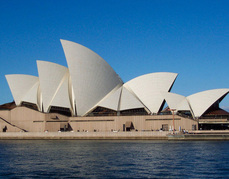
Famous yet dysfunctional (like Mel Gibson).
This just in: the Australian Opera is piping its own orchestra into its theatre, for performances of Erich Korngold’s Die Tote Stadt.
Apparently, the cramped pit of Sydney’s famous yet dysfunctional opera house can’t accommodate an orchestra of the required size. So the musicians will be in a studio next door, and their performance will be heard through the auditorium’s sound system.
It occurs to me that it might have made more sense to acknowledge the limitations of the available space – and not even attempt to do an opera that doesn’t fit in the theatre. Yet I also think there’s something inspiring in this technological leap forward. Perhaps, in the not-too-distant future, this approach to staging opera might develop in exciting new directions.
Apparently, the cramped pit of Sydney’s famous yet dysfunctional opera house can’t accommodate an orchestra of the required size. So the musicians will be in a studio next door, and their performance will be heard through the auditorium’s sound system.
It occurs to me that it might have made more sense to acknowledge the limitations of the available space – and not even attempt to do an opera that doesn’t fit in the theatre. Yet I also think there’s something inspiring in this technological leap forward. Perhaps, in the not-too-distant future, this approach to staging opera might develop in exciting new directions.
So let’s imagine a future production of Don Giovanni in Sydney – as seen through the eyes of a last-minute replacement conductor who’s just flown in for the opening night. Our maestro arrives at the theatre, shortly before the performance is to begin. Yet he finds no one backstage except for an assistant stage manager.
“Where’s my orchestra?” he asks in dismay.
“Maestro,” the ASM replies, “they’re all in an aircraft hangar on the other side of town, ready for your downbeat. They’ll see you on a television screen, and you’ll hear them through loudspeakers in the hall.”
“But why do you need to do that?” the conductor inquires. “Surely you could fit a Mozart-sized orchestra into the pit!”
“That’s true, Maestro,” the ASM acknowledges, “but the acoustics in the hangar are much better.”
“And where’s my chorus? Are they somewhere else in Sydney?”
“They’re somewhere else – but not in Sydney. We had to hire a chorus in Perth, because our own chorus was double-booked to perform in a virtual concert in Tokyo. Of course, they didn’t actually go to Tokyo. They’ll be right here, singing Beethoven’s Ninth in a rehearsal room, while you’re conducting Don Giovanni.”
“What about the cast?”
“They’re all holographic projections. Our Don Giovanni is in New York, Leporello is in Milan, Donna Elvira is in Buenos Aires, and I believe Masetto is somewhere in the Scottish Highlands.”
“Do you really think this is going to work?”
“It should. The sword-fight is a bit tricky, because the Don and the Commendatore can’t actually see each other. And we had a problem in rehearsal because our Leporello got the time-difference between Europe and Sydney wrong. So his entry in the Catalogue Aria was an hour late. But I’m told that’s all been sorted out.”
“And what about the scenery?”
“It’s all computer-generated projections, done by a special-effects company out of Los Angeles.”
“So I suppose I’m the only thing in this entire production that’s actually present in the theatre?”
“Not quite, Maestro. We do have a statue.”
© Colin Eatock 2012
“Where’s my orchestra?” he asks in dismay.
“Maestro,” the ASM replies, “they’re all in an aircraft hangar on the other side of town, ready for your downbeat. They’ll see you on a television screen, and you’ll hear them through loudspeakers in the hall.”
“But why do you need to do that?” the conductor inquires. “Surely you could fit a Mozart-sized orchestra into the pit!”
“That’s true, Maestro,” the ASM acknowledges, “but the acoustics in the hangar are much better.”
“And where’s my chorus? Are they somewhere else in Sydney?”
“They’re somewhere else – but not in Sydney. We had to hire a chorus in Perth, because our own chorus was double-booked to perform in a virtual concert in Tokyo. Of course, they didn’t actually go to Tokyo. They’ll be right here, singing Beethoven’s Ninth in a rehearsal room, while you’re conducting Don Giovanni.”
“What about the cast?”
“They’re all holographic projections. Our Don Giovanni is in New York, Leporello is in Milan, Donna Elvira is in Buenos Aires, and I believe Masetto is somewhere in the Scottish Highlands.”
“Do you really think this is going to work?”
“It should. The sword-fight is a bit tricky, because the Don and the Commendatore can’t actually see each other. And we had a problem in rehearsal because our Leporello got the time-difference between Europe and Sydney wrong. So his entry in the Catalogue Aria was an hour late. But I’m told that’s all been sorted out.”
“And what about the scenery?”
“It’s all computer-generated projections, done by a special-effects company out of Los Angeles.”
“So I suppose I’m the only thing in this entire production that’s actually present in the theatre?”
“Not quite, Maestro. We do have a statue.”
© Colin Eatock 2012
 RSS Feed

